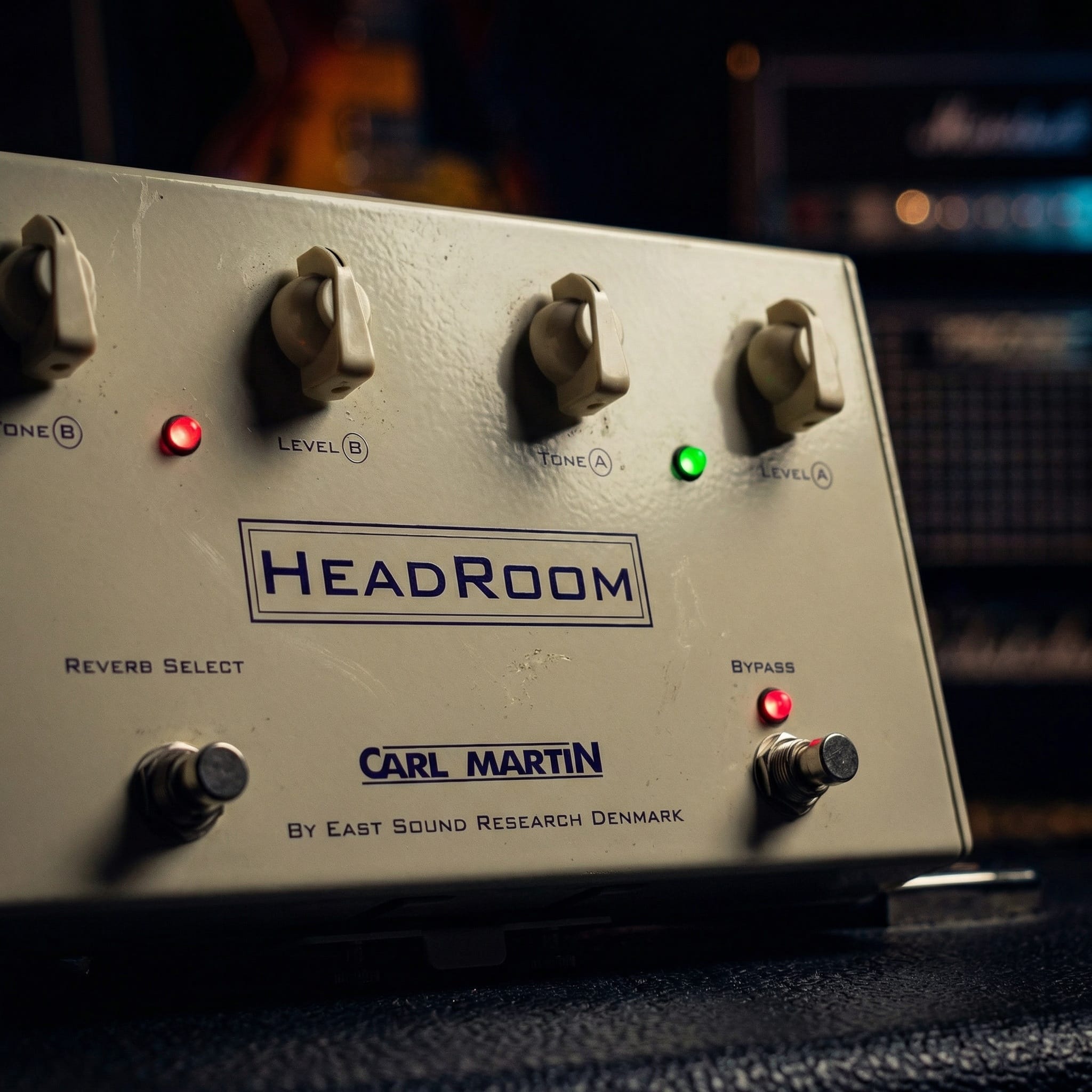
HeadRoom
- Real analog spring reverb with two independent, instantly switchable channels.
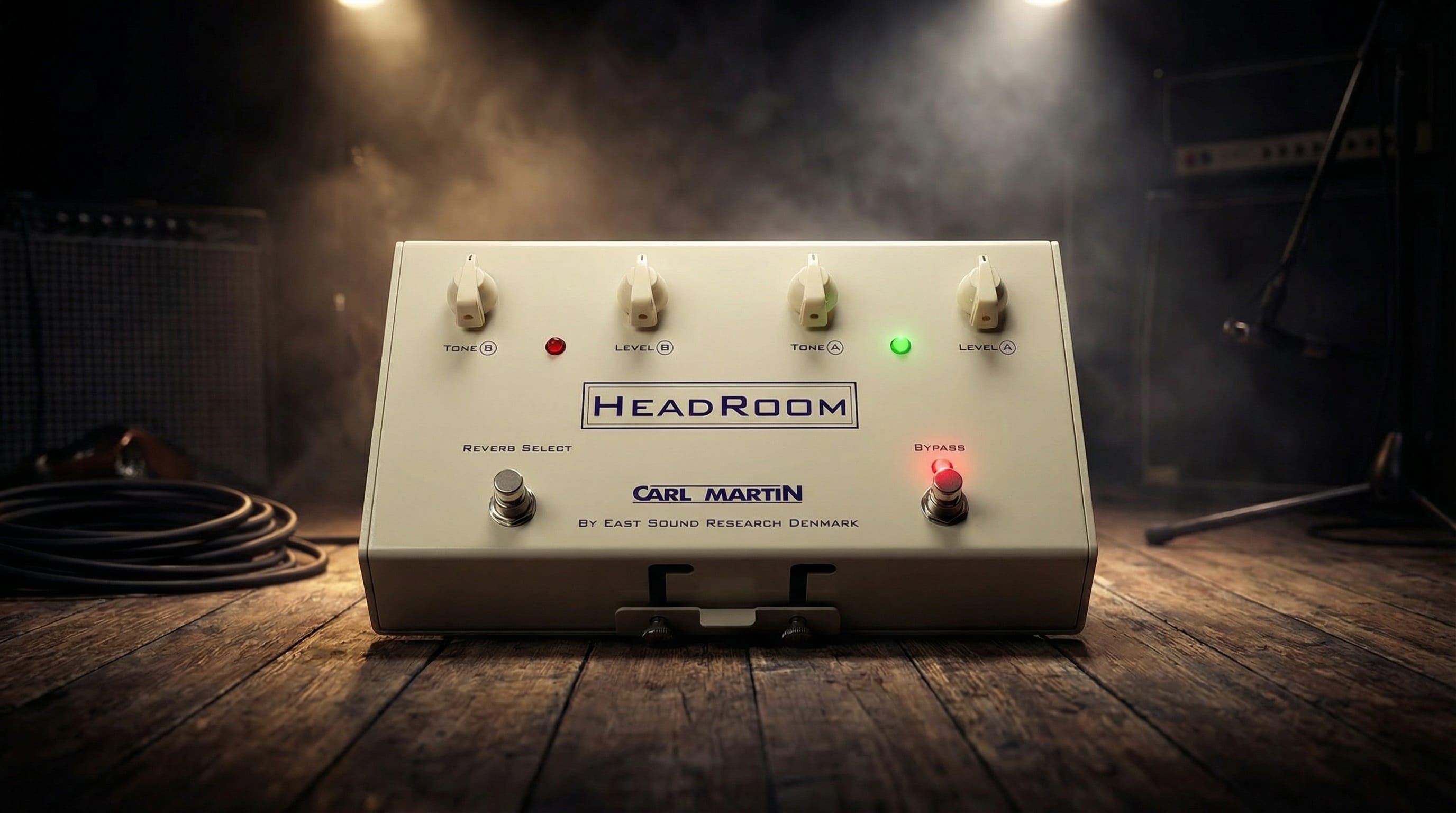
- Each channel features its own Tone and Level controls for two distinct reverb sounds.
- Dual-suspension spring tank mounting reduces sensitivity to stage vibration and feedback.
- Remote jacks for Bypass and Channel Select allow flexible placement and easy control from the floor.
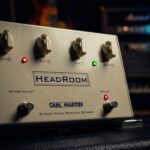
- Rugged metal enclosure with classic chicken-head knobs, designed for straightforward, road-ready operation.
All about Carl Martin HeadRoom
When we designed HeadRoom, the idea was simple: real spring reverb, without complexity — but with flexibility where it actually matters. Instead of menus or presets, we built a fully analog spring reverb with two identical, independent channels that can be switched instantly while you play.
Each channel has its own Tone and Level controls, allowing us to set up two completely different reverb characters. One channel can be dialed in for a subtle, short room sound, while the other delivers a deeper, darker, and more dramatic reverb. Switching between them feels like moving between two separate reverbs built into the same amp.
At the heart of HeadRoom is a real spring reverb tank. We mount it using a dual-suspension system to reduce sensitivity to stage vibration and feedback. The result is a natural, organic reverb response that reacts dynamically to your playing instead of behaving like a static effect layered on top.
We designed HeadRoom for flexible placement. Alongside the standard input and output jacks, we added remote jacks for Bypass and Channel Select. This allows you to place the unit in a rack or behind an amp while still controlling it from the floor — saving valuable pedalboard space without sacrificing functionality.
The enclosure is solid metal, fitted with classic chicken-head knobs, and built to handle real-world use. HeadRoom is straightforward to operate, road-ready, and designed for players who want authentic spring reverb with immediate access to two distinct sounds — no programming required.
Hear it in action
Watch and hear this product in use. Select more videos below.
More videos
FAQ
Quick answers about this pedal — shipping, power, use-cases and more.
What is the Carl Martin HeadRoom?
The HeadRoom is a real analog spring reverb pedal – effectively a genuine spring reverb tank in a stompbox format. It contains actual springs to create reverb, just like the reverb in a classic Fender amp. Uniquely, it has two switchable reverb channels, so you can set two different reverb levels (small room vs large hall sound, for example) and toggle between them, much like having two presets of reverb on stage.
How do the two reverb channels work?
The HeadRoom has two identical reverb channels, labeled A and B, each with its own Tone and Level knobs. Level sets the mix/depth of the reverb (from very subtle to very wet), and Tone adjusts the brightness/darkness of the reverb tail. There are two footswitches: one is Bypass (on/off for the effect), and the other is Channel Select (toggles between A and B). This means you can dial, say, Channel A as a short, subtle reverb (Level low, Tone perhaps brighter for a “small room” vibe) and Channel B as a big, deep surf reverb (Level high, Tone maybe lower for a dark, large hall). Then with the footswitch you can jump from A to B mid-song. It’s like having two reverb presets – very handy for players who want, for instance, a light reverb on rhythm and a heavier reverb on ballad solos or ambient sections.
Is it really a spring reverb? Can it “crash” if bumped like an amp reverb?
Yes, it’s a true spring reverb unit. Inside are small spring tanks. If you physically kick or shake the pedal, you will hear that classic spring “crash” noise (though they mounted the springs with a double suspension to reduce microphonics and stage rumble feedback). So in normal use on the floor, it’s stable; but intentionally whacking it or dropping it will cause a thunderous spring crash – which some players actually find fun to use as an effect! It’s genuinely the same technology as an outboard reverb tank or amp reverb, not a digital emulation. That’s why the HeadRoom’s sound is very authentic – it’s as if your signal is being sent to a little amp’s reverb section and back.
How does the HeadRoom compare to digital reverb pedals?
The HeadRoom’s advantage is its authenticity. Being analog springs, it nails that vintage reverb character (a slightly metallic, organic ambience) that digital algorithms often attempt to emulate. The tone is described as very musical and natural – “like an organic part of the guitar sound rather than an effect tacked on”. It’s particularly excellent for surf, rockabilly, classic rock, blues – any style where a Fender-style spring reverb is desired. However, it’s not as versatile as digital multi-reverbs: you won’t get plate, hall, shimmer, etc. It basically does “small spring” and “big spring” sounds. Also, it has a limited decay length (short pan springs, so it won’t do super long cavernous trails like a digital pedal can). But within its realm, it sounds arguably better than digital – as one review put it, “sound-wise it’s the real deal”. So if you primarily want spring reverb, the HeadRoom is top-tier for sound quality. It’s a more specialized tool, whereas digital pedals are broader but can be less convincing for true spring tone.
Can I run the HeadRoom in stereo or in an amp’s effects loop?
The HeadRoom is a mono pedal (one input, one output, plus it has remote footswitch jacks for channel and bypass if you want to rack-mount it). It’s designed to go in front of an amp or in an amp’s loop – either works. If your amp has an effects loop, putting the HeadRoom there will make it behave exactly like built-in amp reverb (after the preamp distortion, which is ideal). If you run it in front of a clean amp, that’s fine too (most vintage amps didn’t have loops and did reverb before power amp). If you run it in front of a distortion pedal or dirty amp, note that reverb before heavy distortion can sound washy (that’s just physics), so usually it’s best after dirt. But yes, it can handle instrument or line level; its headroom is quite high since it runs internally around ±12V (it actually can be powered by 9V DC or a 9V battery or 12V AC adapter – it has internal power options). As for stereo – it’s not stereo out of the box. It’s a pure analog spring circuit (mono). For stereo, you’d need two units or accept mono reverb to both channels.
Does the HeadRoom require any special power?
The pedal can be powered by a standard 9V DC (center negative) supply at ~200 mA, and interestingly it can also run on a 9V battery or a 12V AC adapter, depending on version. It has an internal power transformer (older versions actually had an AC mains plug; newer are DC). The Guitarist UK review mentions it can run off a 9V battery (though likely with short life given it’s driving a spring driver amplifier). Carl Martin themselves recommend using a regulated power supply for best performance (the springs can pick up hum, so a clean supply is good). If running on a pedalboard, give it isolated 9V. If using battery, ensure it’s fresh; the pedal will warn by dimming LEDs if battery is low. So, nothing too exotic – just note it’s a bit higher draw if using battery. And if yours came with an AC plug, obviously use that or a proper cable as instructed. Check your manual for the specific power method of your unit (there have been a couple of revisions).
Any tips for using the HeadRoom live?
Because it’s real springs, avoid placing it directly on a loud vibrating speaker cab – that could induce some feedback or rumble. They did double-mount the springs to minimize that, but extreme stage vibration can still cause low-frequency howl. A bit of foam or isolation underneath can help if needed. Also, the Tone knobs are very useful: higher Tone = brighter, more splashy reverb; lower Tone = darker, more subtle reverb. In a boomy room, you might dial back Tone to avoid muddy reverb. In a dead room, add some brightness. Use the two channels creatively: maybe Channel A as always on ambient reverb (just a hint of space) and Channel B as a featured effect (big surfy reverb for certain songs). And don’t forget those remote jacks: you can connect external footswitches to control bypass and channel, which means you could mount the HeadRoom off-board (even on top of your amp or on a rack) and still switch it – nice for studios or tidy stage setups. Finally, have fun – kicking the pedal (not too hard) for a spring crash at the end of a song can be a cool showy move (just as one might kick an amp reverb).