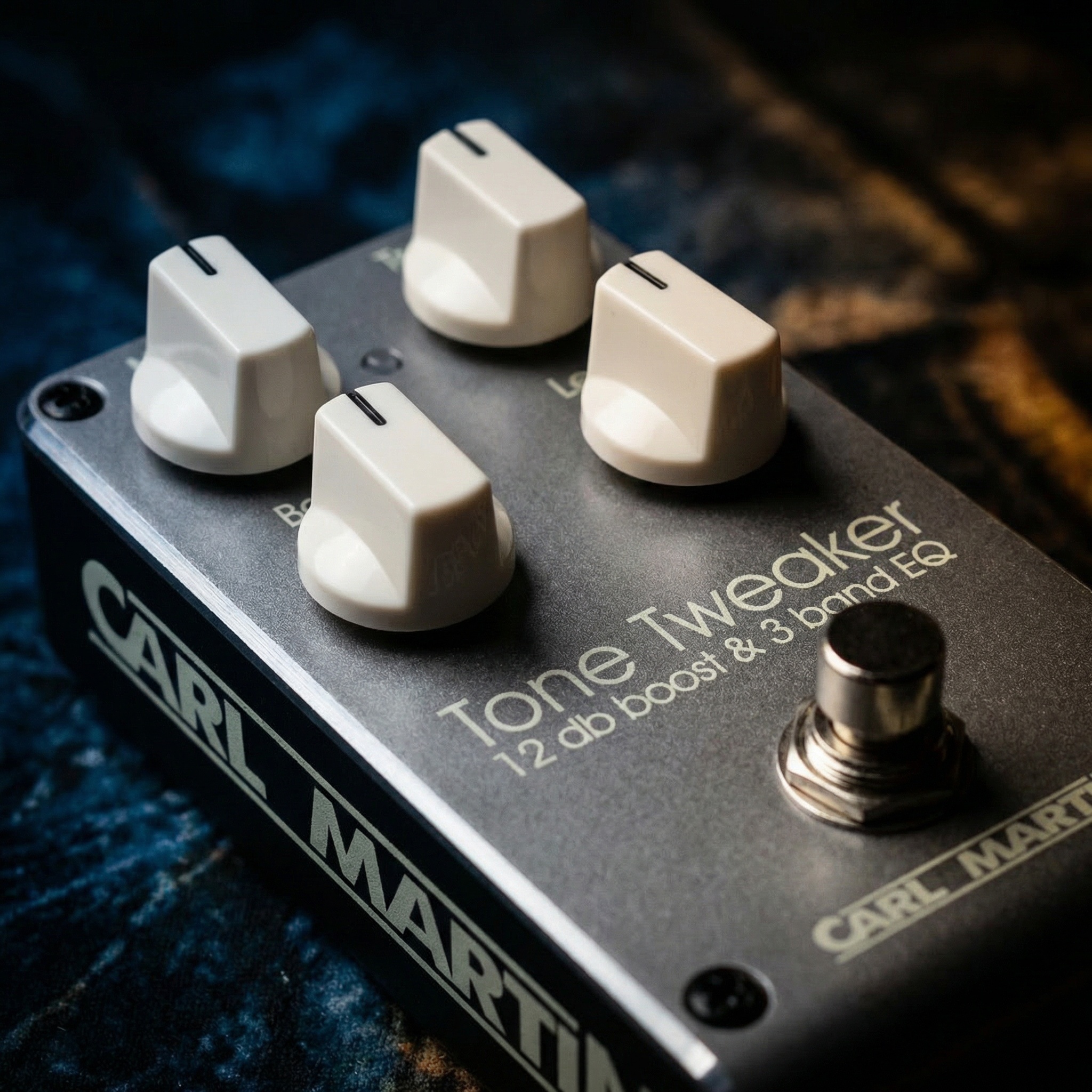
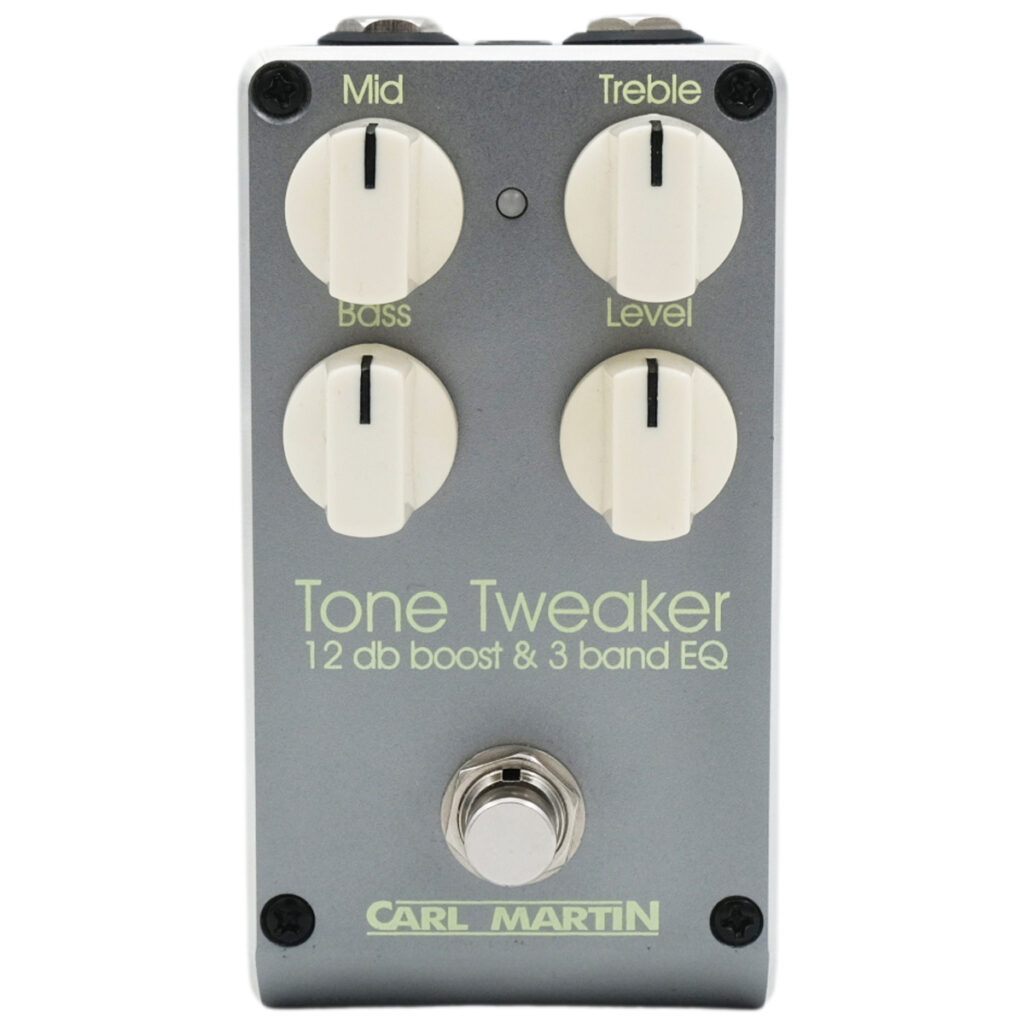
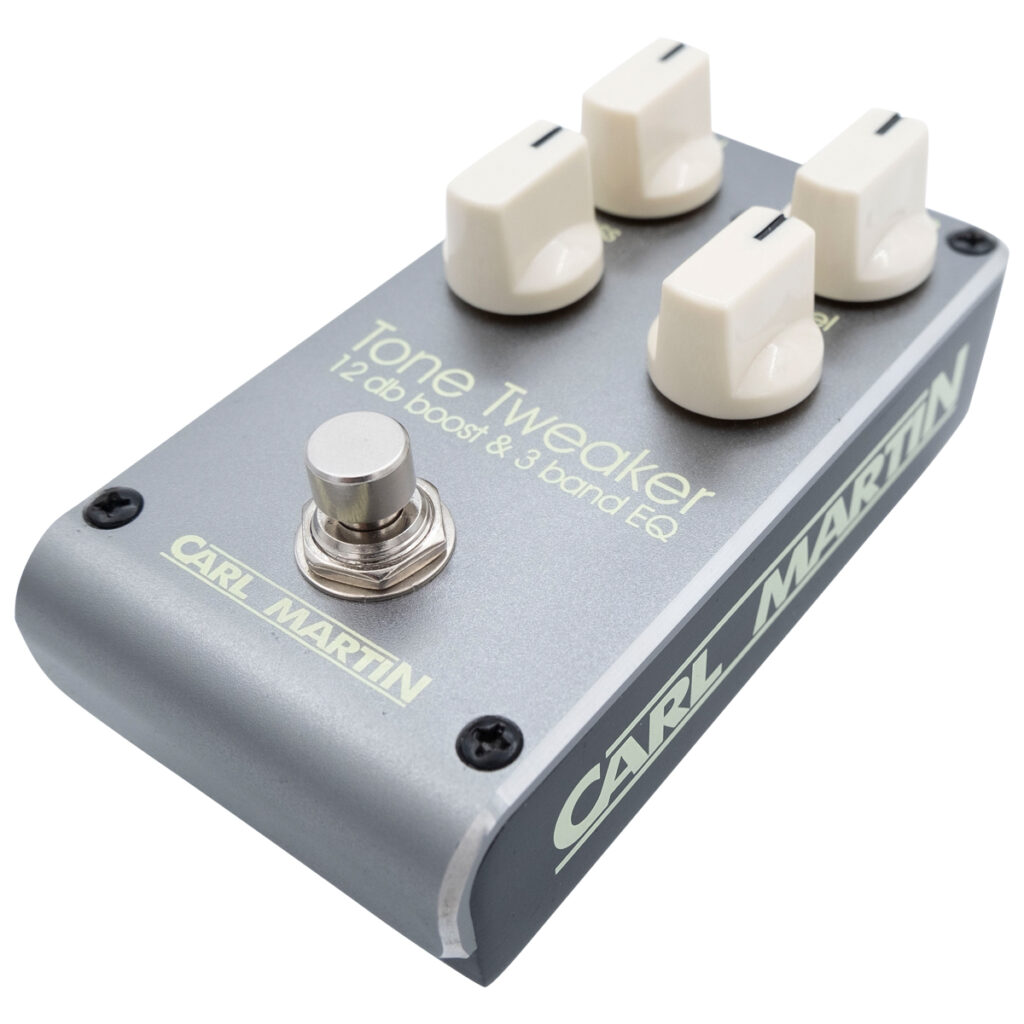
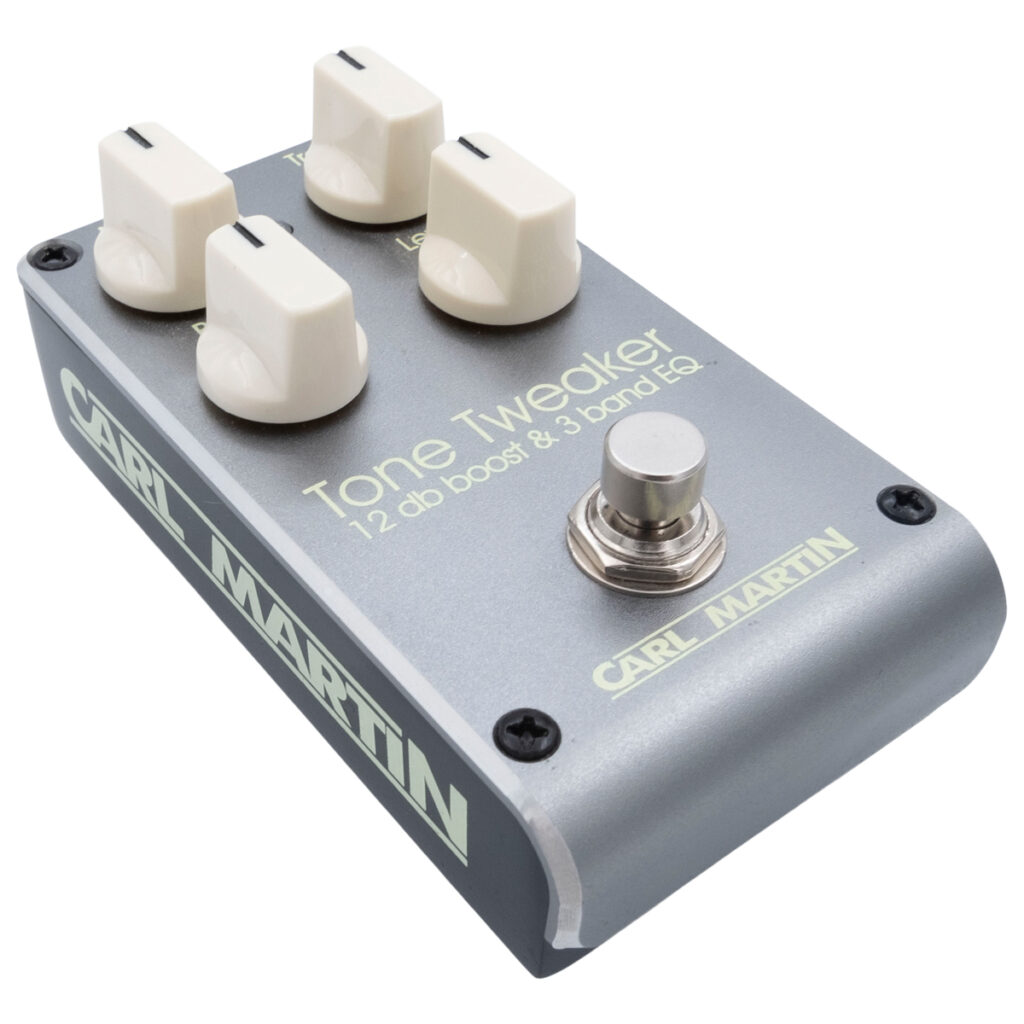
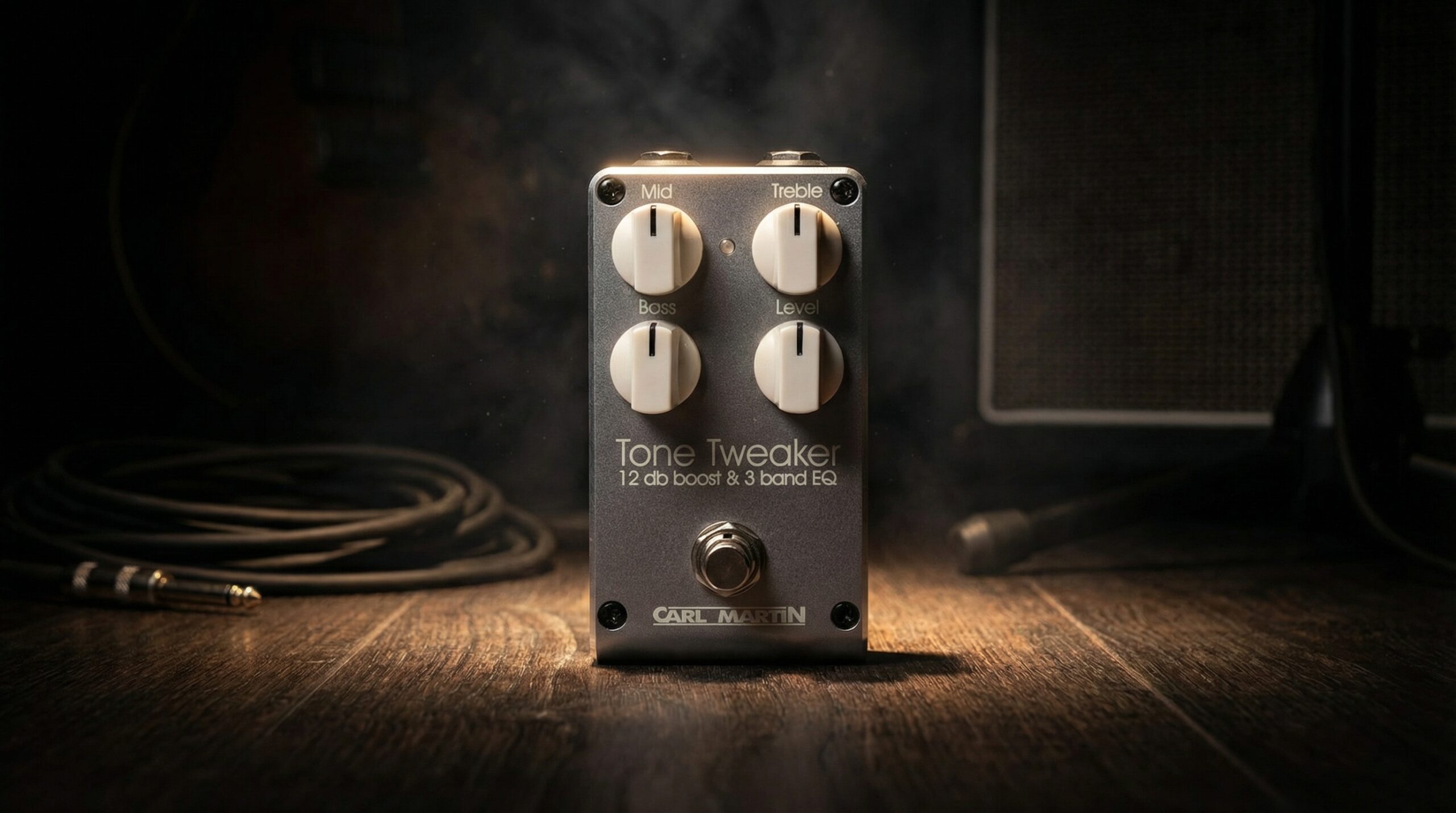
Tone Tweaker
- 3-band EQ with ±12 dB adjustment on Bass, Mid, and Treble for precise, musical tone shaping.
- Up to 12 dB of clean boost to enhance solos, push amps, or add punch to rhythm parts.
- Voltage-boosting design increases headroom, keeping your sound open and composed even at higher settings.
- Buffered output preserves signal integrity in complex setups and long cable runs.
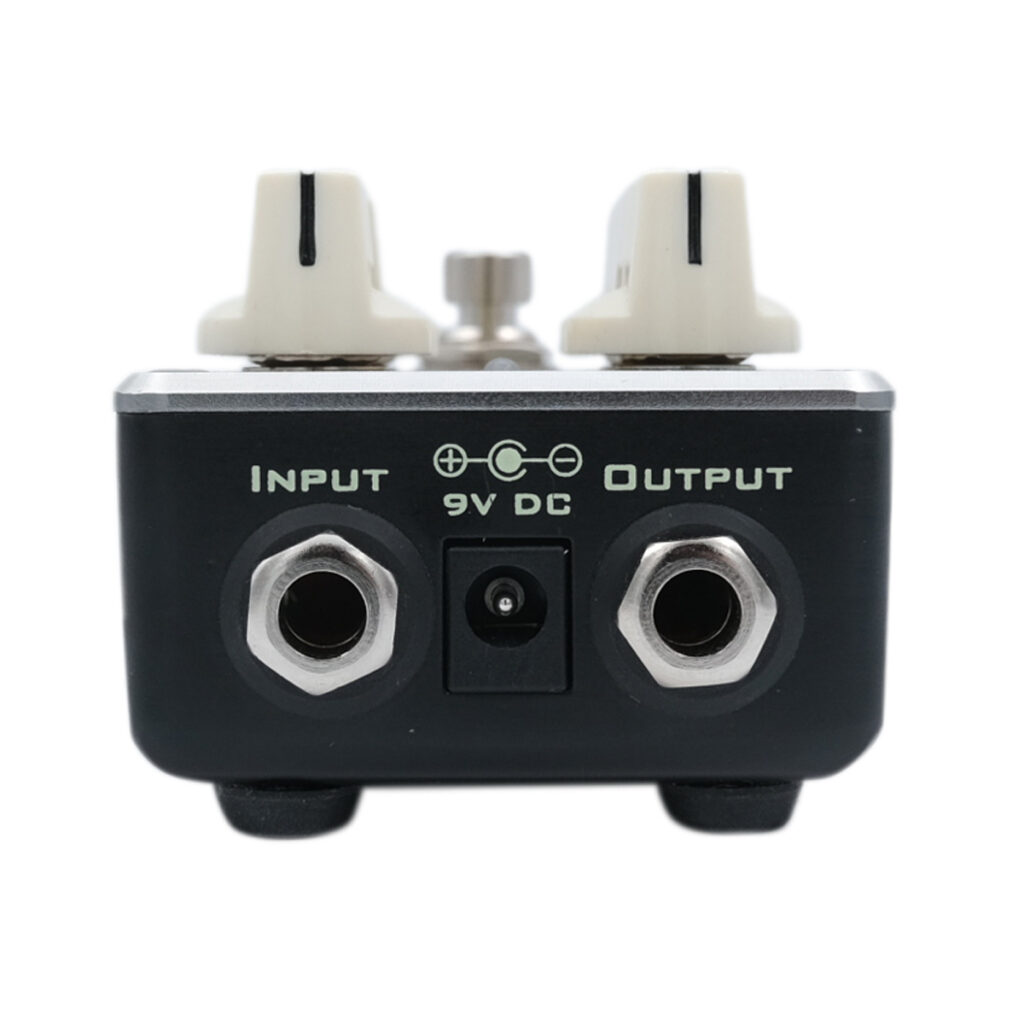
- Simple, intuitive controls in a compact, pedalboard-friendly enclosure for seamless integration.
All about Carl Martin Tone Tweaker
Tone Tweaker was designed to do two things exceptionally well: shape your tone with precision and add clean, controlled boost without changing the character of your rig. It’s not about masking what you already like — it’s about refining it and giving it more authority when you need it.
At the core of the pedal is a 3-band EQ with ±12 dB of adjustment on Bass, Mid, and Treble. Each band is carefully voiced to be musical rather than surgical, making it easy to add weight, presence, or clarity without overcorrecting. Subtle adjustments go a long way, whether you’re compensating for room acoustics, switching guitars, or dialing in a specific part in the mix.
Tone Tweaker also includes up to 12 dB of clean boost, allowing you to lift your signal for solos, push the front end of an amp, or simply bring more punch to your rhythm sound. Internally, the pedal uses a voltage-boosting design to increase headroom, helping it stay open and composed even when the EQ and level are pushed.
With its wide frequency range and low-noise performance, Tone Tweaker works just as well at the front of a pedal chain as it does later in the signal path. The buffered output helps preserve signal integrity, especially in more complex setups with longer cable runs.
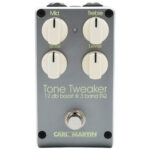
The layout is deliberately straightforward: Mid, Treble, Bass, and Level. No presets, no modes — just direct control over how your sound is shaped and how hard it hits. Built in a compact, pedalboard-friendly enclosure, Tone Tweaker is a practical tone-shaping tool designed to integrate seamlessly into real-world rigs.
Hear it in action
Watch and hear this product in use. Select more videos below.
More videos
FAQ
Quick answers about this pedal — shipping, power, use-cases and more.
What is the Carl Martin Tone Tweaker?
The Tone Tweaker is a combination 12 dB clean boost and 3-band EQ pedal. It’s essentially an active tone-shaping tool: you get an adjustable Bass, Mid, Treble EQ section and up to +12dB of overall boost available. It’s designed to let you fine-tune your guitar’s tone (hence “Tone Tweaker”) – whether that’s adding warmth to a thin sound, taming harsh highs, or just giving your signal a clean lift for solos.
How do the controls work?
The pedal has five knobs. Three are for EQ: Bass, Mid, Treble – active controls that cut or boost their respective frequency bands. Then there’s a Level knob which controls the overall output/boost (up to +12dB at max). And lastly a Master On/Off footswitch (the pedal is single-footswitch; it doesn’t have separate footswitch for boost vs EQ – it’s all engaged together). Internally, it also has an “internal voltage booster” – not a control, but a design feature raising headroom so even when boosting frequencies, it stays clean and doesn’t distort easily. So, practically: set your EQ knobs to taste (they’re flat/neutral around noon), and adjust Level for how much boost you need. If you want it purely as an EQ with no volume change, set Level to unity (around 10-12 o’clock depending on EQ settings). If you want it as a boost, crank Level higher. It’s quite straightforward – like having an amp’s EQ section in pedal form, with an added volume boost if desired.
Is the Tone Tweaker transparent? Does it affect my tone when knobs are neutral?
Yes – with Bass, Mid, Treble set at 12 o’clock (neutral) and Level at unity, the Tone Tweaker is very transparent (it uses high-quality active EQ circuits that keep your core tone intact). The signal goes through a buffer/active circuitry (the pedal is buffered bypass by design), but that buffer is studio-grade – meaning, if anything, it might even improve signal clarity over long cable runs. When engaged and set flat, you shouldn’t hear any difference except maybe a slight tightening of tone due to the low output impedance of the pedal. Essentially, it can be used as a “tone insurance” buffer even without EQ’ing, or as a very clean boost with EQ flat. And of course, once you start turning knobs, it intentionally affects tone (that’s the point!). But in doing so, it’s still very clean – boosting or cutting frequencies doesn’t introduce noise or weird artifacts. It’s described as subtle yet powerful in effect.
What can I use the Tone Tweaker for?
Many things! Here are some common uses:
Solo Boost: Kick it on for leads – use the EQ to maybe add a little mid and treble, and Level to boost volume so your solos cut through. It preserves your tone while making it louder and more focused (almost like a amp’s EQ footswitch).
Fixing Problematic Guitars or Amps: If you have a guitar that’s a bit thin or bright, you can dial in more Bass or cut Treble to sweeten it. Or if your amp is dark, add some Treble presence or upper mids. It’s like having a fine-tuning post-EQ for your rig.
Always-on Tone Enhancer: Some players leave it on all the time as an always-on preamp to “sweeten” their clean and dirty tones. For example, adding a touch of Mid can make your guitar sound more full in a band mix. It’s subtle but effective – hence the “tweaker” name, it’s for those last 5-10% adjustments.
Acoustic/Electric versatility: It’s also great if you switch between guitars – say a single-coil Strat and a humbucker Les Paul. You could stomp it when using one guitar to compensate (e.g., boost mids for the Strat or cut boomy bass for the Les Paul) to get a consistent tone across instruments.
As an EQ in effects loop: If your amp lacks a
Is the Tone Tweaker pedal noisy, especially when boosting treble or using a lot of boost?
No, it’s designed to be extremely low-noise. Carl Martin gave it a buffered bypass and high headroom internal power, which means even at +12dB boost it stays clean and quiet. Of course, boosting any frequency will also boost any noise present from your guitar or previous pedals. For example, if you crank Treble and your single-coils hum, that hum’s high-frequency portion will get louder. But the pedal itself doesn’t introduce hiss. In fact, one key feature is “no added noise” despite powerful EQ – it’s mentioned that it provides “pure, clean power for your effects” (borrowing phrasing from power supplies, but in context it means it won’t mess up your noise floor). If you experience noise, it’s likely from other sources or a power supply issue. Use a good isolated power source for it (draw is modest, around 60 mA). The internal voltage booster and buffered design keep it stable and quiet. Users generally report that even boosting highs doesn’t introduce hiss – which is a testament to its circuitry quality.
Why is it buffered bypass and what does that mean for me?
The Tone Tweaker is a buffered bypass pedal, meaning when the pedal is off, your signal still goes through an active buffer circuit. Carl Martin chose this to ensure that even in bypass, your tone remains strong (no high-end loss over long cables). This buffer is very neutral and actually beneficial if you have other true bypass pedals – it’ll prevent tone suck in a big pedalboard. The only practical difference: if you have a fuzz or other pedal that likes to “see” your guitar’s direct impedance, placing Tone Tweaker (or any buffer) before it could change how that fuzz responds. But typically, you’d place Tone Tweaker later in chain or as an always-on type device. In summary, the buffered bypass is a plus for most, as it preserves signal clarity and eliminates any popping or switching noise. It also allows the EQ to smoothly come in/out without abrupt jumps in tonal character.