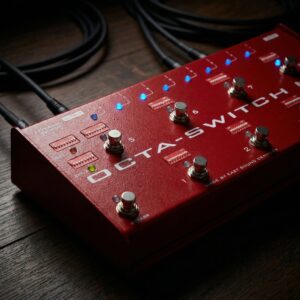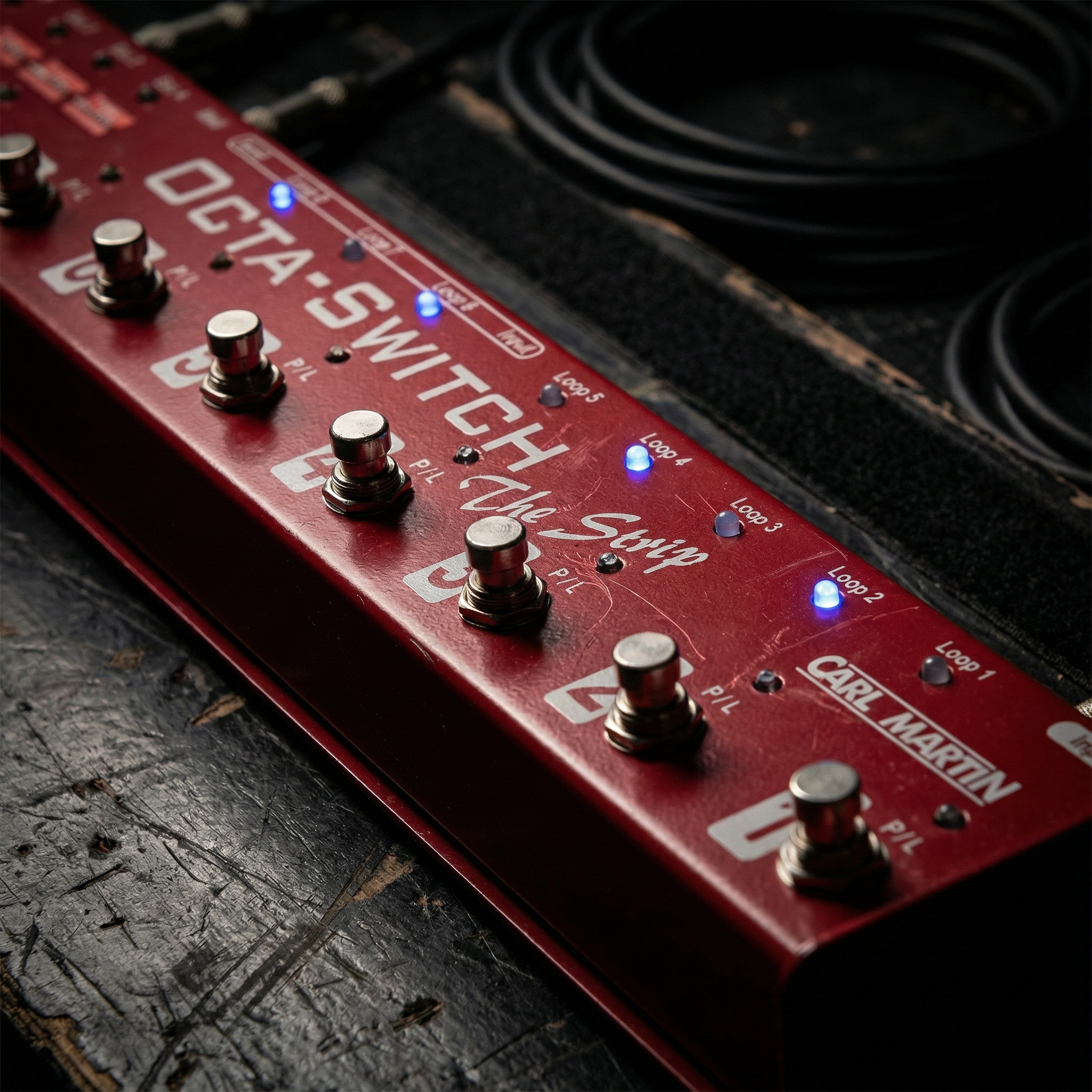
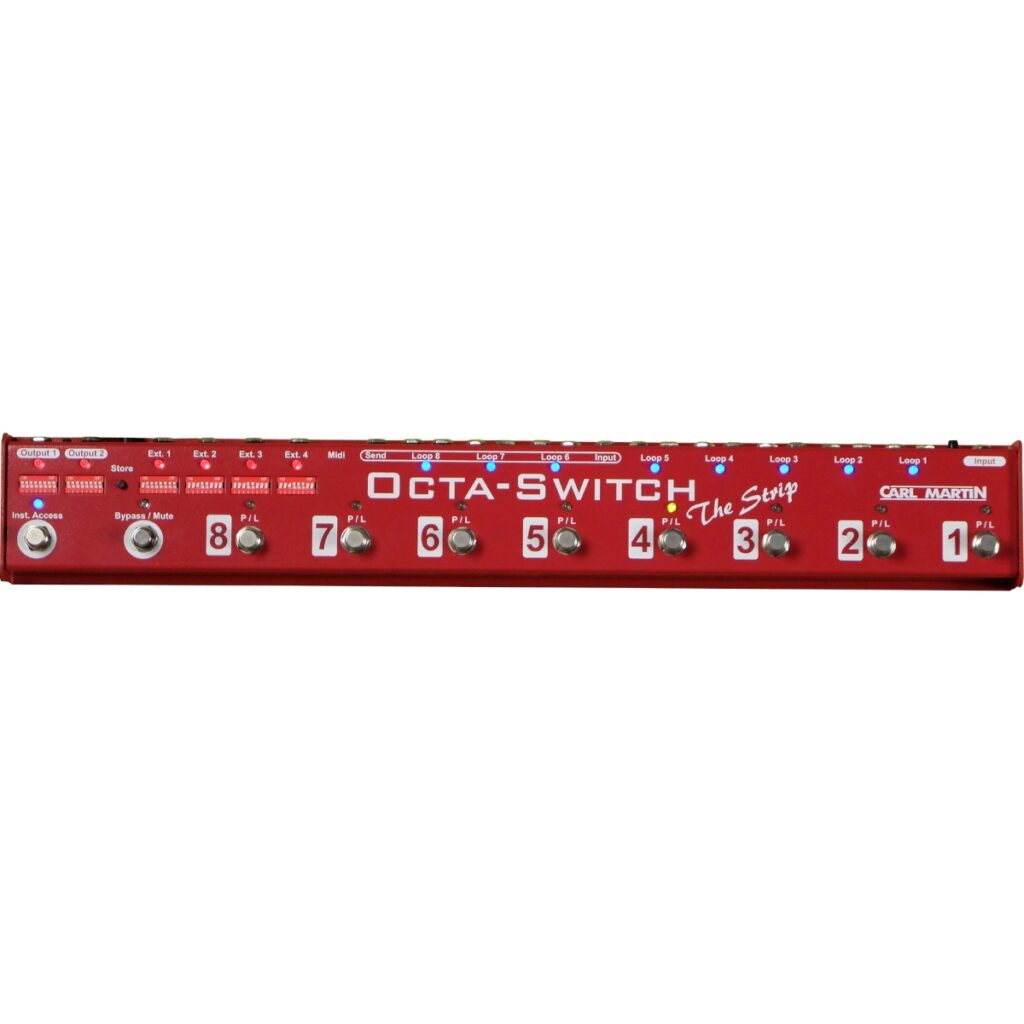
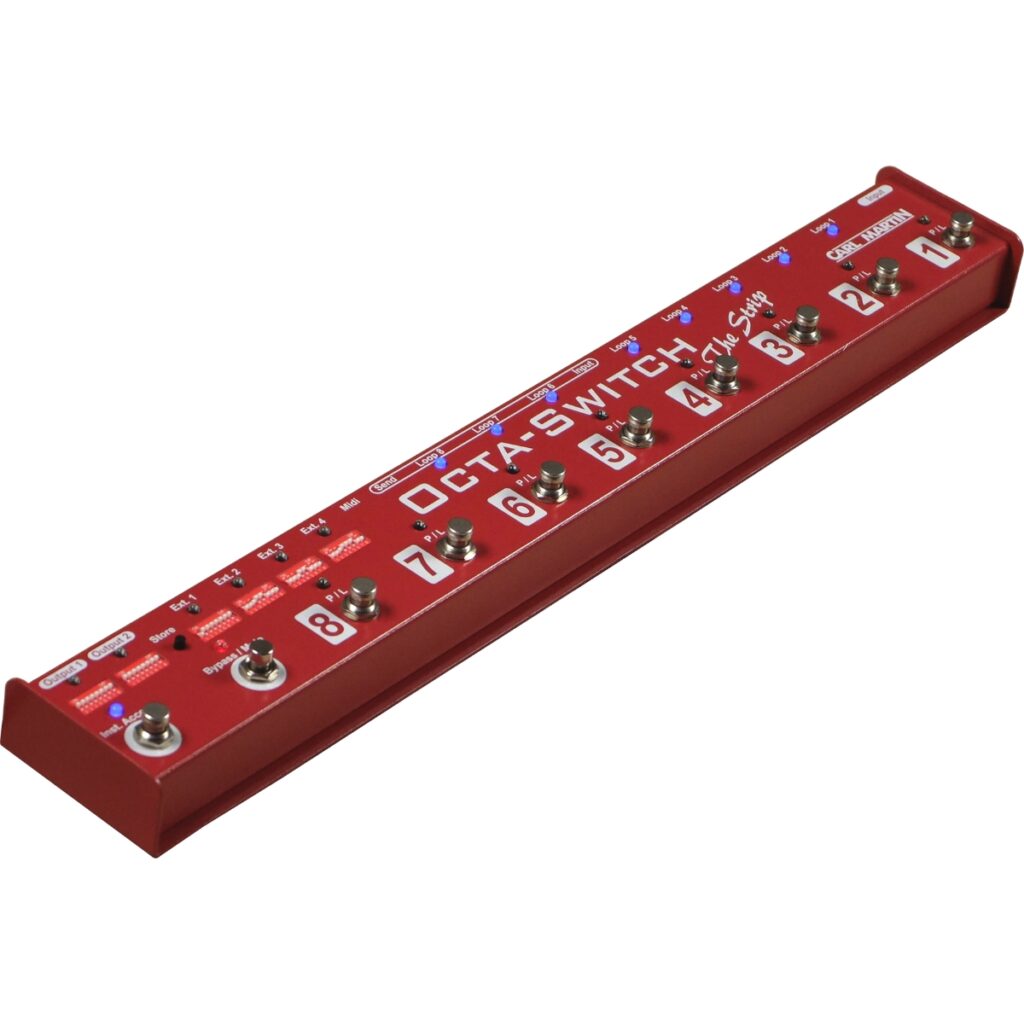
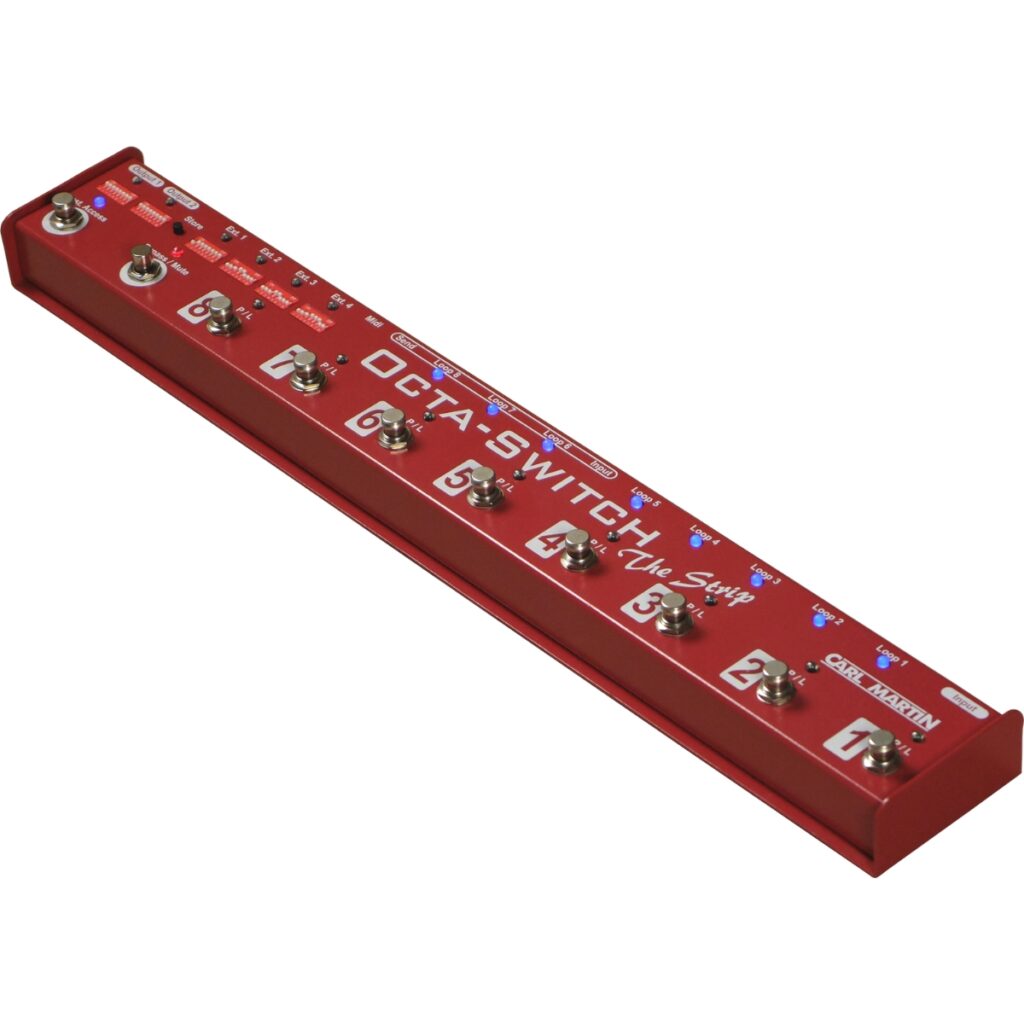
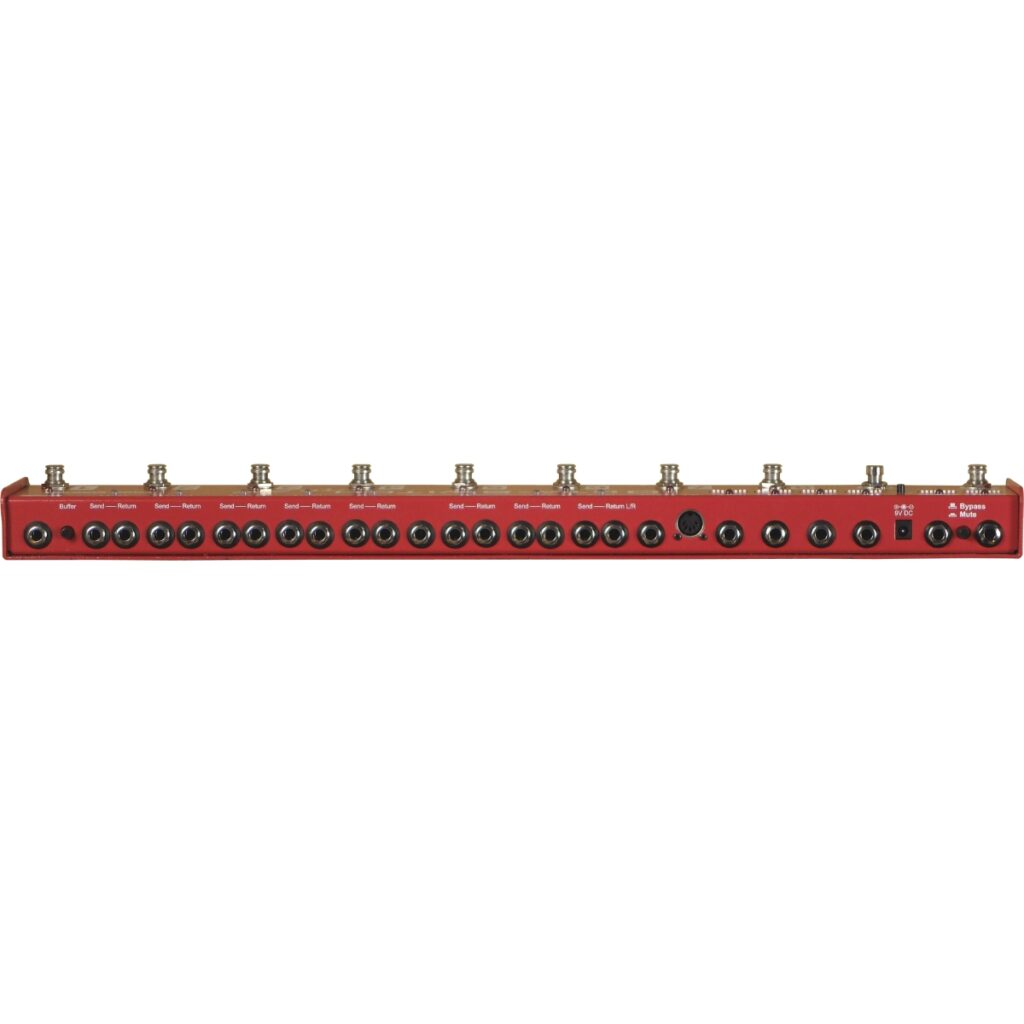
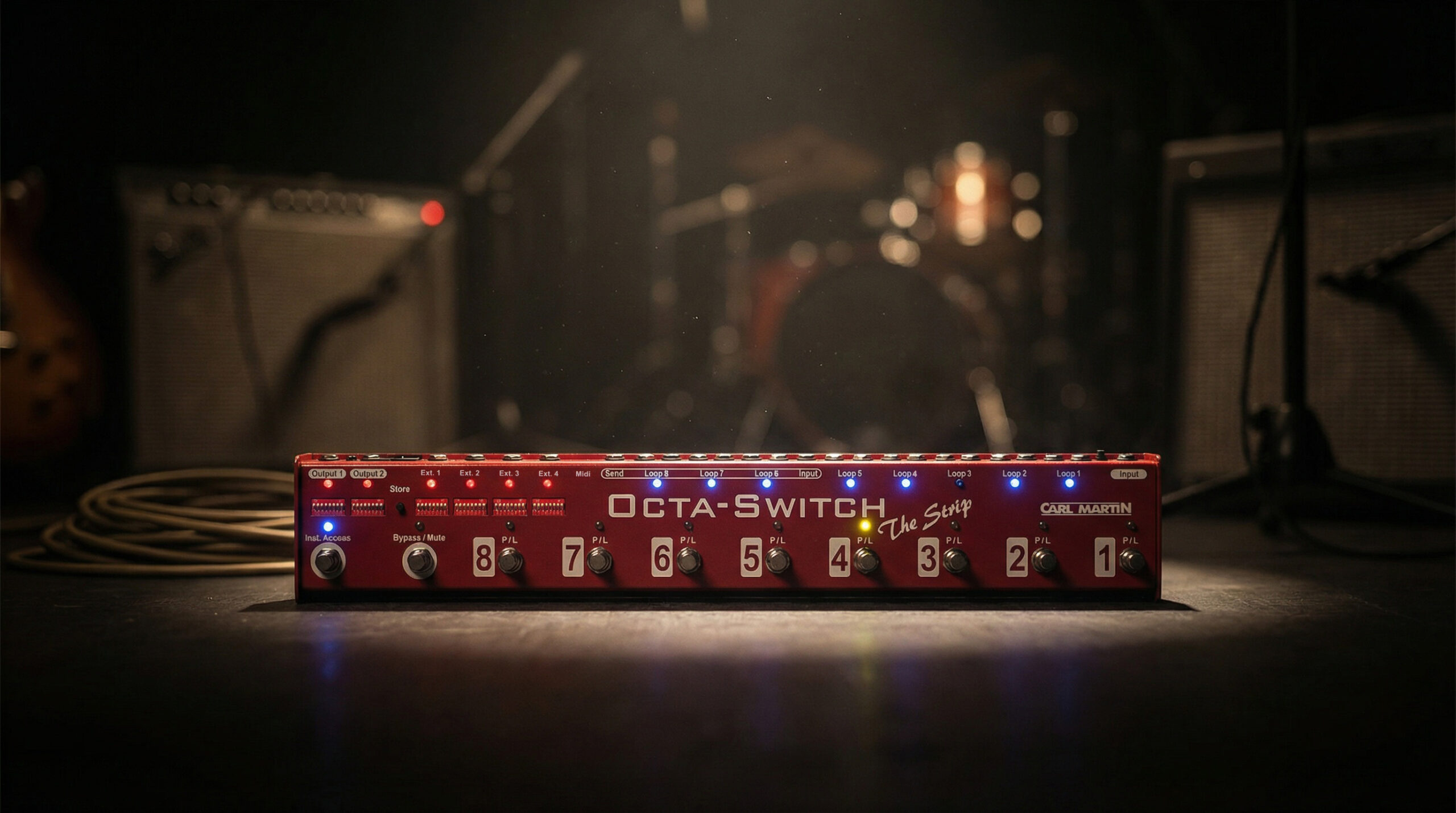
Octa-Switch The Strip
- Eight true-bypass relay loops with impedance-free gold relays, ensuring complete tone transparency and compatibility with any pedals, vintage or modern.
- Instant preset recall across eight programmable presets with a single footswitch press, using reliable hardware-based programming with no menus or digital interface.
- Switchable true-bypass or buffered input adapts to any pedalboard size and cable length, maintaining signal stability from small boards to large stages.
- Four external switching outputs enable direct control of amp channels, multiple amplifiers, and other external devices without additional gear.
- Low-profile strip enclosure designed to fit naturally along the front edge of pedalboards, maximizing foot access while minimizing stage footprint.
All about Carl Martin Octa-Switch The Strip
When we developed Octa-Switch The Strip, the goal was to take everything we’ve learned from three generations of Octa-Switch and distill it into the most compact, stage-friendly format possible — without giving up control, transparency, or reliability. This is the most streamlined and advanced all-analog Octa-Switch we’ve built to date.
Designed and refined once again by Thomas Guldmann, The Strip keeps the core concept intact: eight true-bypass relay loops, programmable into eight presets, recalled instantly with a single footswitch press. Each loop uses impedance-free gold relays, allowing us to run any pedals — vintage or modern — without tone loss or compatibility issues.
The input can be set to true bypass or buffered operation. This lets us adapt the unit to anything from small pedalboards to large stages with long cable runs, while keeping the signal stable and consistent. Visual feedback is immediate, with clear LEDs showing both active loops and the selected preset.
Where The Strip goes further is in flexibility and layout. We added four external switching outputs, making it easy to control amp channels, multiple amplifiers, or other external devices directly from the unit. Everything is laid out in a long, low-profile enclosure that fits naturally along the front edge of a pedalboard — keeping foot access clean and predictable.
Programming remains hardware-based and dependable. Once the presets are set, they behave exactly the same every night. No menus, no screens, no firmware — just solid analog switching that does what it’s told, every time.
Octa-Switch The Strip is built for players who want total control over complex rigs, with the smallest possible footprint and zero digital compromise.
Hear it in action
Watch and hear this product in use. Select more videos below.
More videos
FAQ
Quick answers about this pedal — shipping, power, use-cases and more.
What is the Octa-Switch The Strip?
The Octa-Switch The Strip is a programmable, stage-friendly loop switcher built to simplify complex pedalboards without compromising tone. You get 8 true-bypass loops and 8 preset switches (“banks”) so you can recall complete pedal combinations with a single press—no tap dancing. It’s designed to be fast, intuitive, and rugged, with a “what you see is what you get” approach that keeps things practical for real-world gigging.
How is The Strip different from the Octa-Switch MK3?
The Strip is commonly described as a more modern/refined take on the Octa-Switch idea, adding practical live features like MIDI functionality, external switching options, and flexible routing features that many players need today. It still stays focused on simplicity—programmable loop switching without deep menus or “computer-like” workflow.
How many loops does it have, and are they true bypass?
It has 8 loops (often listed as 7 mono + 1 stereo), and the loops are true bypass using relay switching—so when a loop is off, it’s physically removed from your signal path. That helps keep your core tone intact even with lots of pedals connected.
Does The Strip have a built-in power supply?
No. The Strip does not have a built-in pedal power supply. It runs on an external 9V DC (regulated), center-negative adapter, and the adapter is not included. Plan for a supply that can deliver sufficient current (often stated around 600 mA recommended).
What does “Instant Access mode” mean?
Instant Access mode lets you temporarily add/remove loops inside a bank without overwriting the stored preset. In practice, that means you can start from a preset “base sound” and then kick an extra loop on/off for a section—without needing a dedicated new preset for that small change. It’s a very gig-friendly feature for improvising during a set.
Does The Strip support MIDI? What can I actually do with it?
Yes—The Strip supports MIDI (commonly listed as MIDI out sending program changes), which allows it to control or sync with MIDI-capable devices (for example, a delay/reverb unit, switchable amp, or rack effect) by recalling matching programs when you change banks. It’s aimed at practical “preset recall” integration rather than deep MIDI editing.
What are the “external relay switches” for?
The Strip is designed to control more than pedals in loops. It includes external switching outputs (often referenced as multiple external switches) that can be assigned to things like amp channel switching, amp reverb, boost, or other gear that accepts simple contact-closure switching. This is one of the biggest reasons players choose The Strip over bare-bones loopers: it can become the “central foot controller” for your rig.
Can I run two amps or a stereo setup?
Yes. The Strip is commonly listed with assignable outputs suitable for stereo or dual-amp rigs. That lets you route your board to two amps (or two channels) in a controlled way—useful for wet/dry setups or stereo time-based effects.
Will it “tone suck,” or do I need a buffer?
The core design is built around preserving tone (true-bypass loop switching). Some sources also mention the ability to choose true bypass or buffered bypass at the main input, which is useful if you’re on a big stage or running long cable lengths. In practice: use true bypass if your cable runs are short and your pedals behave well; use buffered input if you need extra signal stability across long runs.